01 / Overview
Crypto Market Prediction Systems
A personal ML research system connecting cryptocurrency forecasts with probability calibration, market replay and execution tooling, with reproducible experiments and explicit financial checks.
- Tools
- Python, TensorFlow, Keras, NumPy, PostgreSQL, SQLAlchemy, Docker, PyTorch
- When
- April 2026
- Team
- Personal project
Quick proof
- Context
- A personal ML research system connecting cryptocurrency forecasts with probability calibration, market replay and execution tooling, with reproducible experiments and explicit financial checks.
- Role
- Independent developer and researcher
- Key contributions
- I develop the prediction and evaluation systems, from research data and model experiments to custom market replay and execution tooling.
- Outcome
- Built an experimental workflow spanning data storage, training, saved predictions, calibration, replay and separately controlled execution. The current workflow uses Python commands and configuration files; a statistics dashboard remains planned. Evaluation has exposed important limits: a saved countdown model trails current-direction persistence at all nine comparable countdown points. The October financial comparison qualified in none of its four required views; reliable profitability is not established. The latest optimizer experiment passed its fixed synthetic update checks, but the projected preparation cost exceeded its readiness limit. Research continues; this is not evidence of a completed profitable trading product.
See the project


Details
Why?
This project brings together my longstanding interests in finance and machine learning. I wanted to investigate whether models could extract useful information from price movements and turn it into better forecasting decisions. It became my first practical ML project and a way to explore a difficult problem with real constraints.
The central question developed beyond predicting the right direction: would a prediction still justify an action after prices, fees, available liquidity and uncertainty are taken into account? That distinction matters because an attractive accuracy score can still produce a poor financial result.
What?
Crypto Market Prediction Systems is a personal research environment for cryptocurrency forecasting and decision evaluation. One direction concerns five-minute Bitcoin outcomes on Polymarket, including predictions made while a window is already in progress. A separate stream investigates broader Bitcoin movement events across different horizons.
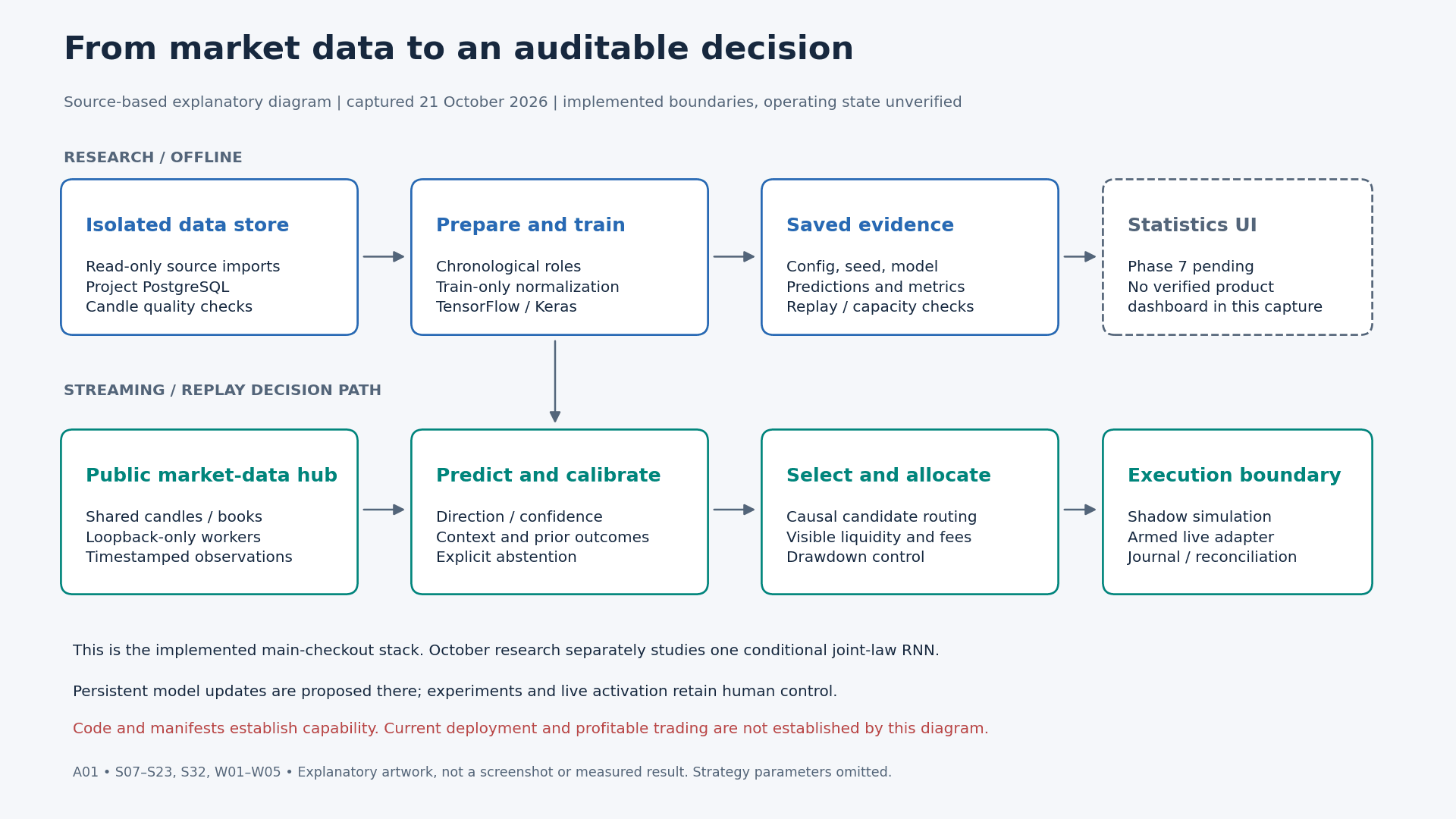
The system includes a research data store, configurable model experiments, saved model bundles and prediction histories, probability calibration and a custom market-replay engine. Replay simulates decisions against recorded order books; shadow execution simulates orders from current observations. A separately controlled live execution adapter includes order journals and reconciliation.
Earlier versions combine multiple models and decision routes. More recent research investigates one model of market and execution outcomes, alongside a decision layer that can decline an entry. The working interface is command based, with configuration files and reports; a graphical statistics application remains planned.
How?
I started by adapting an existing time-series model for short-term prediction. Its results did not meet my needs, so I began building my own models and surrounding infrastructure. The project developed alongside tutorials, lectures, scientific papers, statistics and data-science study. Earlier experiments included PyTorch; the inspected current research stack uses Python, TensorFlow/Keras and NumPy.
The data layer uses PostgreSQL and SQLAlchemy, with isolated project storage and import tooling. The base training pipeline checks chronological windows and missing data, keeps input and target windows within their split, and fits normalization on training data. Saved runs retain configuration, seeds, model metadata, predictions and training histories so results can be traced back to an experiment.
Evaluation compares forecasts with simple baselines and separates predictive scores from financial tests. The replay tooling models visible order-book depth, fees, timing, fills and settlement. WebSocket data sharing, Docker Compose services, order journaling and automated checks support the wider system. These are implemented safeguards, not a guarantee that every experiment is free from bias.
I use the failed experiments to refine the next question. The current work includes conditional outcome modelling and investigation of continuing learning from retained state. Those directions are still research: positive historical simulations, a high win rate or a passing software check do not by themselves demonstrate a robust trading advantage.