01 / Overview
Self-Building Neural Networks
Personal research into neural networks that construct themselves during training, supported by an implemented experimental engine and bounded synthetic-task studies.
- Tools
- Python, TensorFlow, Keras, NumPy
- When
- 2026
- Team
- Personal research
Quick proof
- Context
- Personal research into neural networks that construct themselves during training, supported by an implemented experimental engine and bounded synthetic-task studies.
- Role
- Independent researcher
- Key contributions
- I investigate neural-network mathematics and architecture, developing an experimental engine and evaluation workflow for networks that construct themselves during training.
- Outcome
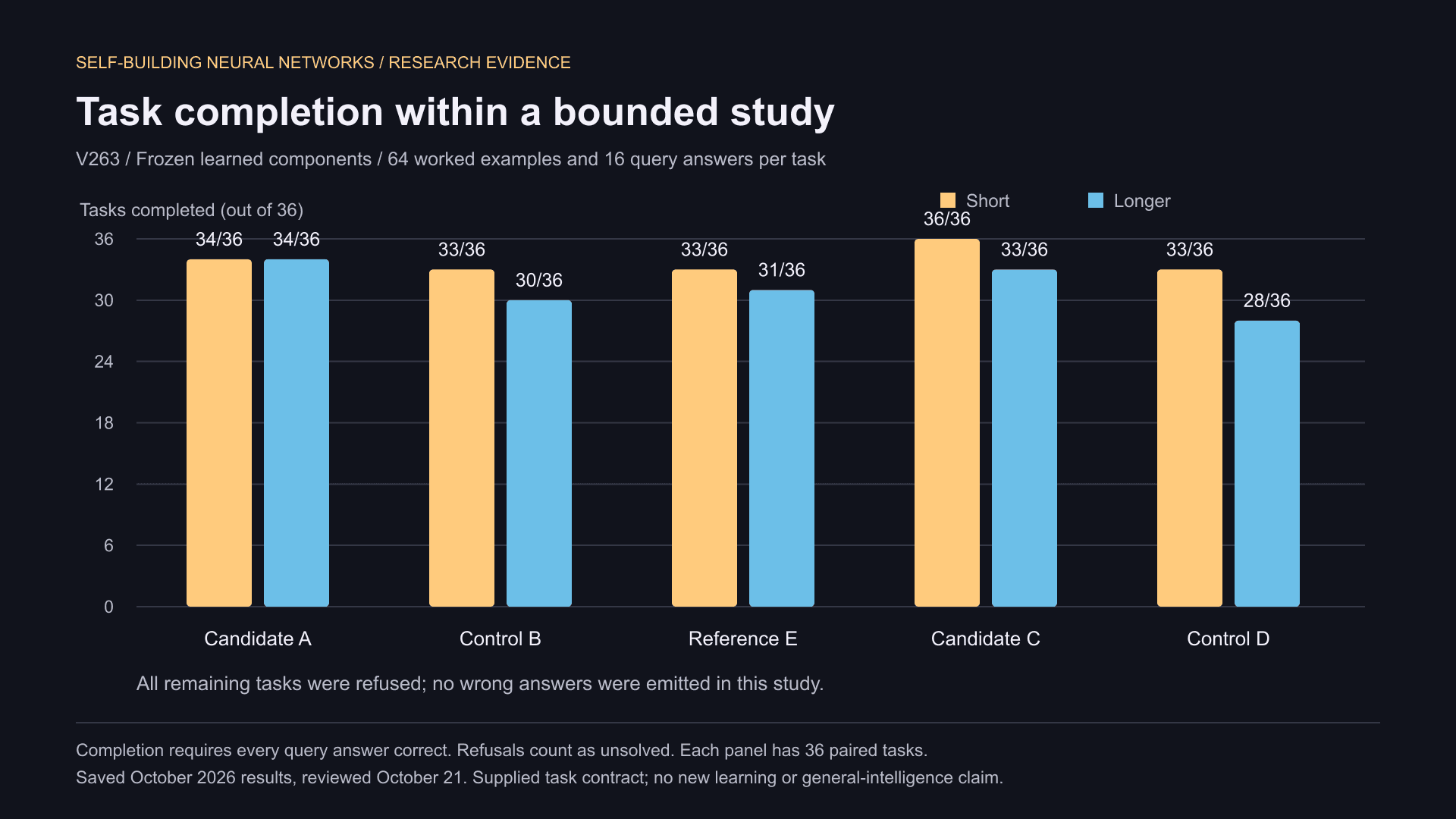
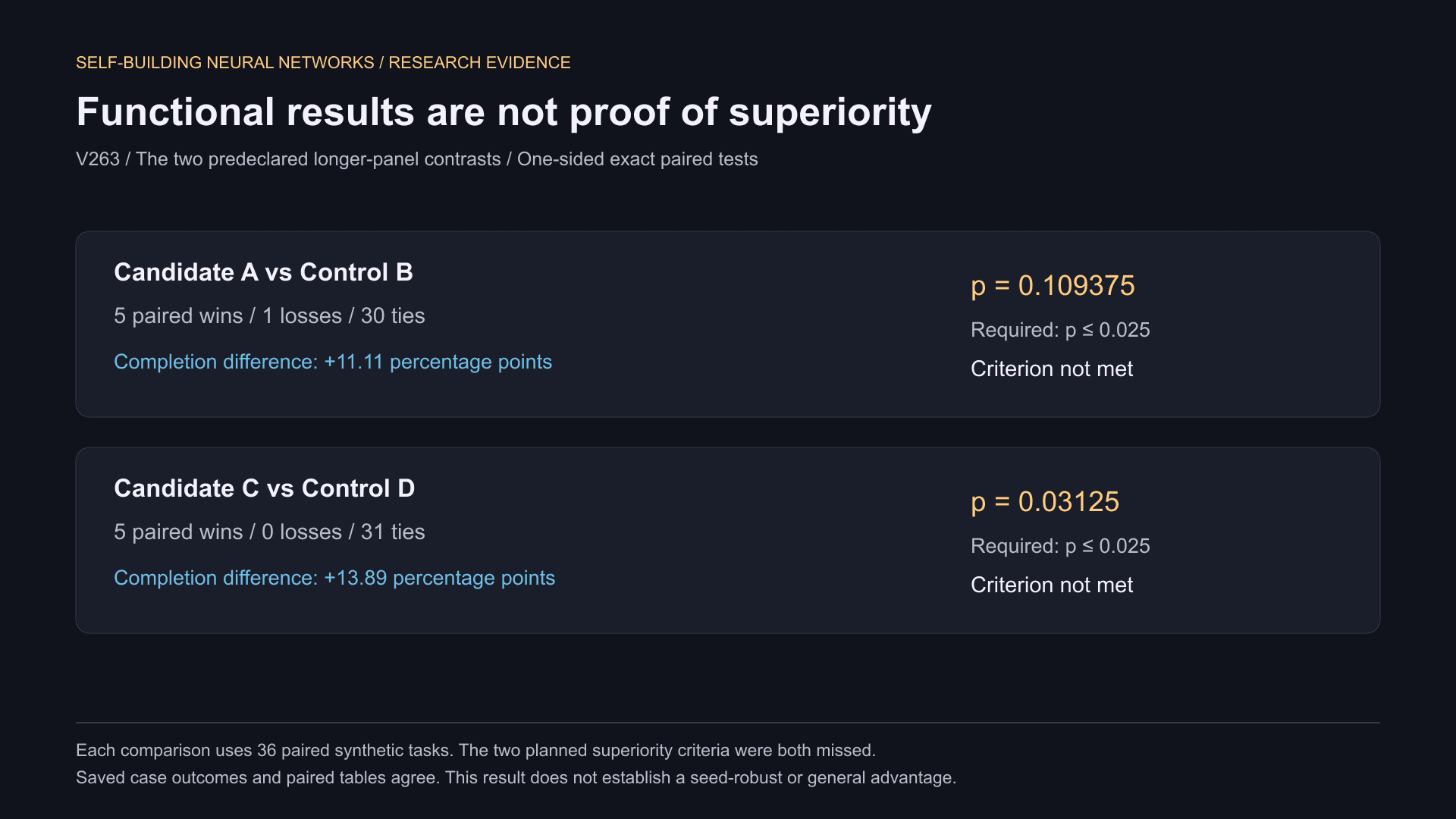
- Implemented research software, saved model state and a command-based experiment interface. The detailed construction mechanism remains private. In one fresh synthetic-task study, Candidate C completed 36/36 short and 33/36 longer tasks. Each task required all 16 query answers to be correct; the remaining longer tasks were refused. No wrong answers were emitted in that study, within its supplied task contract. The planned paired comparison with Control D did not meet its statistical criterion (one-sided p = 0.03125; required p ≤ 0.025). This is a bounded functional result, not established superiority, general intelligence or demonstrated new-skill acquisition.
See the project
Details
Why?
I started this research from questions about neural-network structure and its relationship to reasoning and contextual understanding. I wanted to investigate whether a network could construct useful structure during training rather than rely entirely on a structure chosen beforehand.
The practical motivation is to explore more capable and reusable learning systems. I also hope that useful insights might eventually inform my market-prediction research. These are aims of the work, rather than capabilities I consider established.
What?
Self-Building Neural Networks is a personal research project into a network that constructs itself during training. It now includes an implemented experimental engine, saved learned state, a training and evaluation harness, and a local command interface for running and inspecting experiments.
The current evidence includes controlled synthetic tasks with worked examples and query answers. The evaluation distinguishes completing an entire task, refusing to answer and emitting an incorrect answer. Public plots show training history, task completion and matched comparisons without exposing the network’s internal construction mechanism.
How?
The implementation uses Python, TensorFlow/Keras and NumPy. I work through experimental versions, retain run artifacts and compare candidate behaviour against controls. Automated checks cover research boundaries and interface contracts; separate numerical audits examine saved computation. Passing those checks is distinct from proving an advantage on a task.
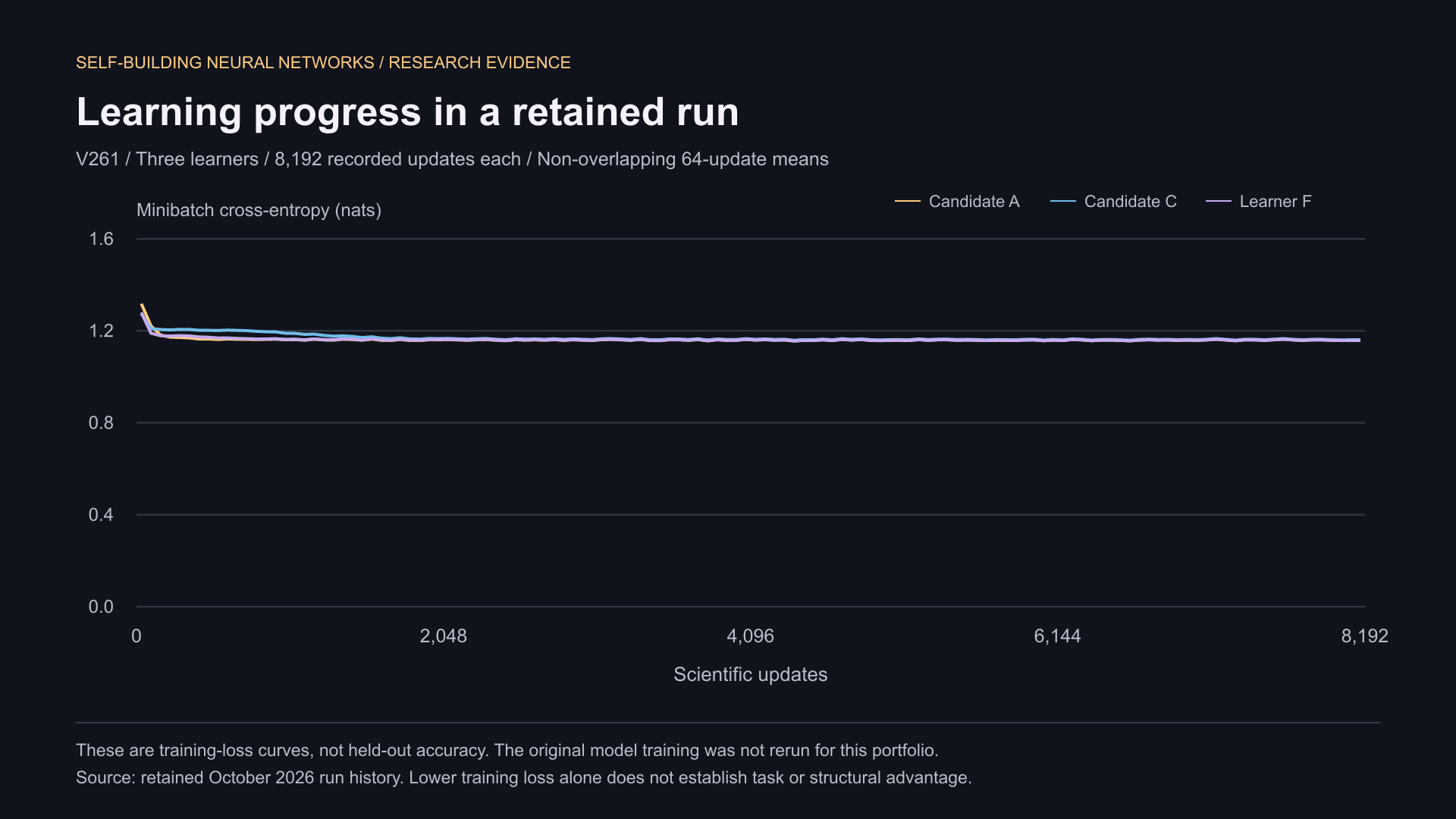
One retained training study records 8,192 scientific updates for each of three learners. Its plotted curves average minibatch cross-entropy over blocks of 64 updates. They describe training progress, not validation accuracy or proof of generalization.
For a later fresh task study, learned components were frozen and reused within a supplied task contract. Each panel contained 36 paired tasks; each task provided 64 worked examples and required all 16 query answers to be correct. Refusals counted as unsolved. Matched controls and predeclared paired tests help separate functional task completion from evidence of a structural advantage.
That study did not train new skills, add components or establish retention after further learning. Those require separate experiments. I am keeping the construction algorithms, mathematical formulation and internal structure outside the public description, while sharing enough evaluation context to explain what the current results do and do not show.